This website is intended for use by US residents only.

CRYSVITA was effective in treating children with XLH

Clinical studies of children with XLH showed that CRYSVITA may help by:

Phosphate element, as shown in the periodic table

Increasing phosphorus levels in the blood and keeping these levels in a normal range

Two bones showing abnormalities

Helping to heal softening and weakening of growing bone (rickets) and improve leg abnormalities

A ruler rotated at a 45-degree angle with an arrow pointing up

Improving growth (height)

How CRYSVITA was studied

The benefits and safety of CRYSVITA were looked at in children with XLH across 3 studies

Number of children

29

on CRYSVITA

32

on conventional therapy

Ages

1-12

years old

Length of treatment

64

weeks

This study (Study 1) compared the effects of CRYSVITA with the effects of oral phosphate and active vitamin D (calcitriol or alfacalcidol). In the study, these supplements are called “active control,” but on this page they are referred to as “conventional therapy.” The study assessed rickets healing and severity, phosphorus levels, and growth.

Number of children

26

on CRYSVITA, taken once every 2 weeks

26

on CRYSVITA, taken once every 4 weeks

Ages

5-12

years old

Length of treatment

64

weeks

After 16 weeks of adjusting the dose, patients received CRYSVITA every 2 weeks for 48 weeks

This study (Study 2) determined a safe and effective dosage for CRYSVITA. It assessed the effects of CRYSVITA on the severity of rickets and healing of rickets, phosphorus levels, and height for different dosing schedules.

Number of children

10

on CRYSVITA,
taken once every 2 weeks

3

on CRYSVITA,
taken once every
2 weeks

(with dose increases during the study)

Ages

1-4

years old

Length of treatment

64

weeks

All patients completed at least 40 weeks on study

The study assessed the effects of CRYSVITA on phosphorus levels, severity of rickets, healing of rickets, and leg abnormalities.

Rickets results

CRYSVITA helped heal rickets in children with XLH

study 1

Children on CRYSVITA had improved healing of rickets at week 40

Change in rickets was assessed using the Radiographic Global Impression of Change (RGI-C) score, which compares X-rays of the wrist and knee over time to see how much the bones have changed. Higher scores mean greater healing of rickets. The average RGI-C score* was 1.9 in patients on CRYSVITA and 0.8 in patients on conventional therapy.

More children on CRYSVITA had substantial healing of their rickets* compared with conventional therapy at week 40
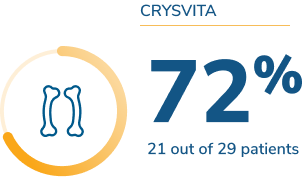
Two bones showing abnormalities

vs

Two bones showing abnormalities

These results were maintained at week 64.

Studies 2 and 3 of children with XLH also found that CRYSVITA helped heal rickets

  • Study 2: After 40 weeks, the average RGI-C score* was +1.7 in children who took CRYSVITA every 2 weeks. 69% (18 out of 26) of the children had substantial healing of rickets.* These results were maintained at week 64
  • Study 3: After 40 weeks, the average RGI-C score* was +2.3 in children who took CRYSVITA. 100% (13 out of 13) of the children had substantial healing of rickets*

* RGI-C is a scale from -3 (severe worsening of rickets) to +3 (complete or near-complete healing of rickets), used to measure the change in rickets. An RGI-C score of 2.0 or higher means substantial healing of rickets.

CRYSVITA helped reduce the severity of rickets in children with XLH

The severity of rickets was assessed using the Thacher Rickets Severity Score (RSS). This is a 10-point scale from 0 (no rickets) to 10 (severe rickets). A lower RSS score means less severe rickets.

Children on CRYSVITA had a greater reduction in the severity of their rickets compared with conventional therapy at weeks 40 and 64

Week 40 results

Two bones showing abnormalities

vs

Two bones showing abnormalities

Week 64 results

Two bones showing abnormalities

vs

Two bones showing abnormalities

All 3 studies of children with XLH found that CRYSVITA led to reduced rickets severity

  • Study 1: After 40 weeks, the average RSS decreased from 3.2 to 1.1 in children who took CRYSVITA compared with a decrease of 3.2 to 2.5 in children on conventional therapy
  • Study 2: After 40 weeks, the average RSS decreased from 1.9 to 0.8 in children who took CRYSVITA once every 2 weeks
  • Study 3: After 40 weeks, the average RSS decreased from 2.9 to 1.2 in children who took CRYSVITA

The average change in RSS at week 40 was -2.0 in children on CRYSVITA compared with -0.7 for those on conventional therapy. At week 64, the average change was -2.2 in the CRYSVITA group compared with -1.0 for conventional therapy. The average RSS at baseline was 3.2 in both groups.

Lower extremity skeletal abnormalities (lower leg abnormalities)

CRYSVITA helped improve bone abnormalities in the legs of children with XLH

Lower leg abnormalities (such as bowed legs or knock knees) were assessed using leg x-rays and a modified version of the RGI-C score to look at leg alignment. Higher scores mean greater improvement.

Children on CRYSVITA demonstrated improvements in bone abnormalities of the lower limbs at 64 weeks

An x-ray of bones

vs

At week 64, children taking CRYSVITA showed greater improvement than those receiving conventional therapy (least squares [LS] mean between-group difference: +0.97; 95% confidence interval [CI]: +0.57, +1.37).

Study 3 also showed that CRYSVITA improved leg abnormalities among children with XLH

  • Study 3: After 40 weeks, children who took CRYSVITA had an average RGI-C score of +1.3 based on leg x-rays

The RGI-C leg score is a 7-point scale that assesses change in leg abnormalities and ranges from -3 (very much worse) to +3 (very much better).

Bella, a person living with XLH, smiling

Bella, currently on CRYSVITA

Real XLH stories

Bella’s experience with CRYSVITA

“For the first time with CRYSVITA, my [phosphorus] levels look normal in comparison to how they’ve been my whole life.”

Phosphorus level results

CRYSVITA improved phosphorus levels in children with XLH

Children on CRYSVITA increased and maintained average levels of phosphorus in the blood compared with conventional therapy from the start of the study to week 64

Phosphate element, as shown in the periodic table

vs

Studies 2 and 3 of children with XLH also showed that CRYSVITA increased and maintained phosphorus levels in the blood within the normal range

  • Study 2: In children who took CRYSVITA every 2 weeks, the average phosphorus levels increased from 2.4 mg/dL to 3.3 mg/dL after 40 weeks and to 3.4 mg/dL after 64 weeks
  • Study 3: In children who took CRYSVITA, the average phosphorus levels increased from 2.5 mg/dL to 3.5 mg/dL after 40 weeks

Normal phosphorus levels in the blood were defined as a range from 3.2 mg/dL to 6.1 mg/dL. The normal range of phosphorus levels in the blood varies by age and sex, and ranges may vary by the lab that does the testing.

Growth results

CRYSVITA increased height in children with XLH

Children on CRYSVITA had a greater average increase in height compared with conventional therapy at 64 weeks

A stadiometer with a silhouette of a person next to it and an arrow pointing up

vs

At the beginning of the study, children taking CRYSVITA and conventional therapy had similar below-average height z-scores (-2.32 and -2.05). At week 64, those taking CRYSVITA showed greater improvement in height than those receiving conventional therapy (LS mean between-group difference: +0.14; 95% CI: 0.00-0.29).

The height z-score measures how close a child’s height is to the average height of all children of the same age and sex.

Study 2 also showed that CRYSVITA helped increase height among children with XLH

  • Study 2: Children taking CRYSVITA every 2 weeks had an increase in height z-score over 64 weeks, from -1.72 at the beginning of the study to -1.54 (LS mean change: +0.19 [95% CI: 0.09-0.29])

What you need to know about the safety of CRYSVITA in children with XLH

Cora, a person living with XLH, standing and smiling with her hand on her hip

Cora, on CRYSVITA since 2018

What you need to know about the safety of CRYSVITA in children with XLH

Cora, a person living with XLH, standing and smiling with her hand on her hip
Indication
What is CRYSVITA?

CRYSVITA is a prescription medicine used to treat adults and children 6 months of age and older with X-linked hypophosphatemia (XLH).


What is CRYSVITA?

CRYSVITA is a prescription medicine used to treat adults and children 6 months of age and older with X-linked hypophosphatemia (XLH).

Important Safety Information

You should not take CRYSVITA if:

  • You take an oral phosphate supplement and/or a specific form of vitamin D supplement (such as calcitriol, paricalcitol, doxercalciferol, calcifediol).
  • Your phosphorus levels from a blood sample are within or above the normal range for age.
  • You have kidney problems.

What is the most important information you should know about CRYSVITA?

  • Some patients developed allergic reactions (e.g., rash and hives) while taking CRYSVITA. Your doctor will monitor you for symptoms of an allergic reaction while you are taking CRYSVITA. Your treatment may need to be discontinued for serious allergic reactions.
  • High levels of phosphorus in the blood have been reported in some patients taking CRYSVITA. This may be related to a risk of high calcium levels in the kidneys. Your doctor will collect blood samples to monitor your levels. If you are already taking CRYSVITA, dose interruption and/or dose reduction may be required based on your serum phosphorus levels.
  • High levels of calcium in the blood have been reported in patients taking CRYSVITA. The risk is greater in patients with pre-existing hyperparathyroidism (overactive parathyroid glands), for those who are unable to move for extended periods of time, become dehydrated, have high vitamin D levels, or have kidney issues. If you are at greater risk, your doctor will monitor your blood calcium and parathyroid hormone levels before you start and while taking CRYSVITA. If you develop high levels of blood calcium, your doctor may need to stop your treatment until it is adequately managed.
  • Administration of CRYSVITA may result in reactions at the injection site, such as hives, reddening of the skin, rash, swelling, bruising, pain, severe itching of the skin, and collection of blood outside of a blood vessel (i.e., hematoma). Call your doctor if you develop an injection site reaction. CRYSVITA may be discontinued if severe injection site reactions occur.

What are the possible side effects of CRYSVITA?

  • Adverse reactions that were seen in children with XLH are:
  • Fever
  • Injection site reaction
  • Cough
  • Vomiting
  • Pain in arms and legs
  • Headache
  • Tooth abscess
  • Dental cavities
  • Diarrhea
  • Decreased vitamin D levels
  • Toothache
  • Constipation
  • Muscle pain
  • Rash
  • Dizziness
  • Nausea
  • Adverse reactions that were seen in adults with XLH are:
  • Back pain
  • Headache
  • Tooth infection
  • Restless legs syndrome
  • Decreased vitamin D levels
  • Dizziness
  • Constipation
  • Muscle spasms
  • Phosphorus levels increased in the blood
  • Narrowing of the spaces within the spine is common in adults with XLH, and pressure on the spinal cord has been reported in adults taking CRYSVITA. It is not known if taking CRYSVITA worsens the narrowing of the spaces within the spine or the pressure on the spinal cord.

Before taking CRYSVITA, tell your doctor about all of your medications (including supplements) and medical conditions, including if you:

  • Are taking oral phosphate and/or active vitamin D (such as calcitriol, paricalcitol, doxercalciferol, calcifediol).
  • Are pregnant, think you may be pregnant, or plan to become pregnant. There is not enough experience to know if CRYSVITA may harm your unborn baby. Report pregnancies to the Kyowa Kirin, Inc. Adverse Event reporting line at 1-844-768-3544.
  • Are breastfeeding or plan to breastfeed. There is not enough experience to know if CRYSVITA passes into your breast milk. Talk with your doctor about the best way to feed your baby while you receive CRYSVITA.

While taking CRYSVITA, tell your doctor if you experience:

  • An allergic reaction such as rash or hives
  • A rash, swelling, bruising, or other reaction at the injection site
  • New or worsening restless legs syndrome

These are not all the possible side effects of CRYSVITA. Call your doctor for medical advice about side effects.

You may report side effects to the FDA at (800) FDA-1088 or www.fda.gov/medwatch. You may also report side effects to Kyowa Kirin, Inc. at 1-844-768-3544.

For important risk and use information, please see the full Prescribing Information for CRYSVITA.

What is CRYSVITA?

CRYSVITA is a prescription medicine used to treat adults and children 6 months of age and older with X-linked hypophosphatemia (XLH).

Important Safety Information

You should not take CRYSVITA if:

  • You take an oral phosphate supplement and/or a specific form of vitamin D supplement (such as calcitriol, paricalcitol, doxercalciferol, calcifediol).
  • Your phosphorus levels from a blood sample are within or above the normal range for age.
  • You have kidney problems.

What is the most important information you should know about CRYSVITA?

  • Some patients developed allergic reactions (e.g., rash and hives) while taking CRYSVITA. Your doctor will monitor you for symptoms of an allergic reaction while you are taking CRYSVITA. Your treatment may need to be discontinued for serious allergic reactions.
  • High levels of phosphorus in the blood have been reported in some patients taking CRYSVITA. This may be related to a risk of high calcium levels in the kidneys. Your doctor will collect blood samples to monitor your levels. If you are already taking CRYSVITA, dose interruption and/or dose reduction may be required based on your serum phosphorus levels.
  • High levels of calcium in the blood have been reported in patients taking CRYSVITA. The risk is greater in patients with pre-existing hyperparathyroidism (overactive parathyroid glands), for those who are unable to move for extended periods of time, become dehydrated, have high vitamin D levels, or have kidney issues. If you are at greater risk, your doctor will monitor your blood calcium and parathyroid hormone levels before you start and while taking CRYSVITA. If you develop high levels of blood calcium, your doctor may need to stop your treatment until it is adequately managed.
  • Administration of CRYSVITA may result in reactions at the injection site, such as hives, reddening of the skin, rash, swelling, bruising, pain, severe itching of the skin, and collection of blood outside of a blood vessel (i.e., hematoma). Call your doctor if you develop an injection site reaction. CRYSVITA may be discontinued if severe injection site reactions occur.

What are the possible side effects of CRYSVITA?

  • Adverse reactions that were seen in children with XLH are:
  • Fever
  • Injection site reaction
  • Cough
  • Vomiting
  • Pain in arms and legs
  • Headache
  • Tooth abscess
  • Dental cavities
  • Diarrhea
  • Decreased vitamin D levels
  • Toothache
  • Constipation
  • Muscle pain
  • Rash
  • Dizziness
  • Nausea
  • Adverse reactions that were seen in adults with XLH are:
  • Back pain
  • Headache
  • Tooth infection
  • Restless legs syndrome
  • Decreased vitamin D levels
  • Dizziness
  • Constipation
  • Muscle spasms
  • Phosphorus levels increased in the blood
  • Narrowing of the spaces within the spine is common in adults with XLH, and pressure on the spinal cord has been reported in adults taking CRYSVITA. It is not known if taking CRYSVITA worsens the narrowing of the spaces within the spine or the pressure on the spinal cord.

Before taking CRYSVITA, tell your doctor about all of your medications (including supplements) and medical conditions, including if you:

  • Are taking oral phosphate and/or active vitamin D (such as calcitriol, paricalcitol, doxercalciferol, calcifediol).
  • Are pregnant, think you may be pregnant, or plan to become pregnant. There is not enough experience to know if CRYSVITA may harm your unborn baby. Report pregnancies to the Kyowa Kirin, Inc. Adverse Event reporting line at 1-844-768-3544.
  • Are breastfeeding or plan to breastfeed. There is not enough experience to know if CRYSVITA passes into your breast milk. Talk with your doctor about the best way to feed your baby while you receive CRYSVITA.

While taking CRYSVITA, tell your doctor if you experience:

  • An allergic reaction such as rash or hives
  • A rash, swelling, bruising, or other reaction at the injection site
  • New or worsening restless legs syndrome

These are not all the possible side effects of CRYSVITA. Call your doctor for medical advice about side effects.

You may report side effects to the FDA at (800) FDA-1088 or www.fda.gov/medwatch. You may also report side effects to Kyowa Kirin, Inc. at 1-844-768-3544.

For important risk and use information, please see the full Prescribing Information for CRYSVITA.

Go to top button

Back to top

COMM-US-CRY-0927 June 2026